
Fostering students’ computational thinking: Student worksheets on integer material
##plugins.themes.bootstrap3.article.sidebar##
##plugins.themes.bootstrap3.article.main##
Abstract
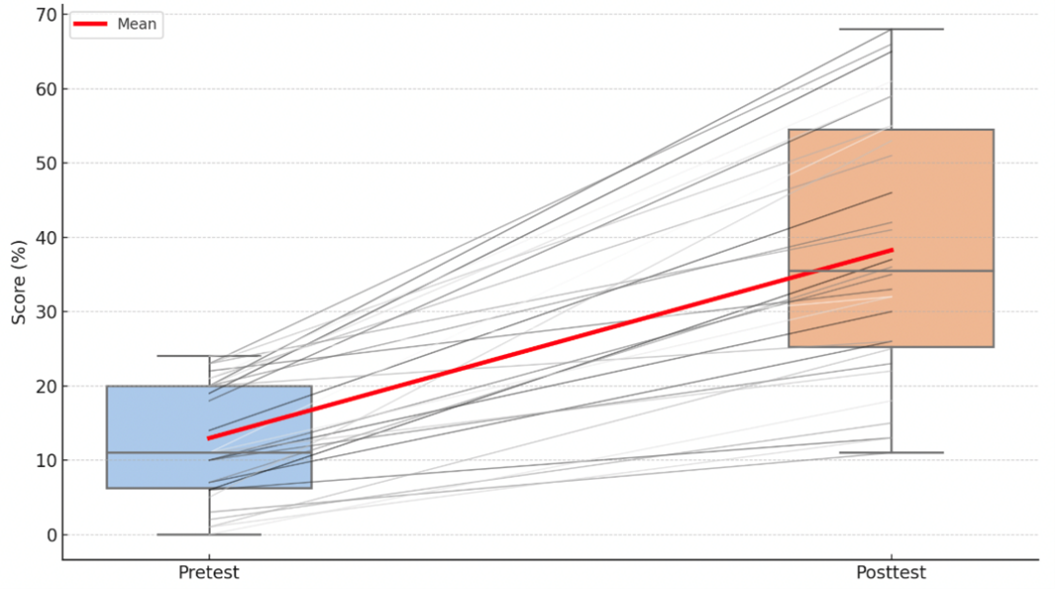
Computational thinking (CT) is a critical 21st-century competency, yet its integration into mathematics education remains underdeveloped. At the same time, previous research has focused on identifying CT difficulties. This study aims to address this gap by developing and validating a CT-based worksheet on integer material to improve students' computational thinking abilities. Using a design research method with a development studies approach, the study involved 30 junior high school students in Palembang. Data were collected via pre- and post-tests and analyzed using the N-Gain score to measure enhancement. Results indicate that the CT-based worksheets significantly improved students' CT skills by 66.58%. The structured problem-solving stages within the worksheets effectively guided students through the CT process. Although the quantitative results show substantial gains, the study notes a limitation in qualitative depth regarding student engagement. These findings suggest that integrating CT-based worksheets into mathematics instruction can foster structured thinking and provide a practical foundation for curricular adaptation. This study contributes to the field of mathematics education by offering a validated instructional tool that bridges the gap between CT theory and classroom practice. These findings provide a foundation for further refinement of computational thinking-based learning materials and their broader application in similar educational contexts.
##plugins.themes.bootstrap3.article.details##

This work is licensed under a Creative Commons Attribution-ShareAlike 4.0 International License.
The author is responsible for acquiring the permission(s) to reproduce any copyrighted figures, tables, data, or text that are being used in the submitted paper. Authors should note that text quotations of more than 250 words from a published or copyrighted work will require grant of permission from the original publisher to reprint. The written permission letter(s) must be submitted together with the manuscript.References
Ainia, C., & Amir, M. F. (2021). Analysis of elementary school students difficulties’ in solving integer word problems. MaPan, 9(2), 304–319. https://doi.org/10.24252/mapan.2021v9n2a8
Akker, J. v. d., Bannan, B., Kelly, A. E., Nieveen, N., & Plomp, T. (2007). Curriculum design research. In T. Plomp & N. Nieveen (Eds.), An introduction to educational design research (Vol. 37, pp. 37–50).
Ansu-Kyeremeh, E. K., & Goosen, L. (2022). Exploring the socioeconomic facet of online inclusive education in Ghana: The effects of technological advancement in academia. In M. B. Garcia (Ed.), Socioeconomic inclusion during an era of online education (pp. 47–66). IGI Global Scientific Publishing. https://doi.org/10.4018/978-1-6684-4364-4.ch003
Challenor, J., & Ma, M. (2019). A review of augmented reality applications for history education and heritage visualisation. Multimodal Technologies and Interaction, 3(2), 39. https://doi.org/10.3390/mti3020039
Chen, K., Ren, X.-t., & Yang, G.-l. (2021). A novel approach for assessing academic journals: Application of integer DEA model for management science and operations research field. Journal of Informetrics, 15(3), 101176. https://doi.org/10.1016/j.joi.2021.101176
Chong, W. W. N., Shahrill, M., Asamoah, D., & Latif, S. N. A. (2022). Non-digital card game and year 8 students’ performance in integers. Journal of Mathematics and Science Teacher, 2(1), em007. https://doi.org/10.29333/mathsciteacher/11928
Csizmadia, A., Curzon, P., Dorling, M., Humphreys, S., Ng, T., Selby, C., & Woollard, J. (2015). Computational thinking: A guide for teachers. Computing At School.
Deda, Y. N., Laja, Y. P. W., & Talan, N. (2024). Effectiveness of using koin muatan teaching aids to improve numeracy skills. International Journal of Research in Education, 4(1), 186–193. https://doi.org/10.26877/ijre.v4i1.16876
Durak, H. Y., Yilmaz, F. G. K., & Yilmaz, R. (2019). Computational thinking, programming self-efficacy, problem solving and experiences in the programming process conducted with robotic activities. Contemporary Educational Technology, 10(2), 173–197. https://doi.org/10.30935/cet.554493
Ghory, S., & Ghafory, H. (2021). The impact of modern technology in the teaching and learning process. International Journal of Innovative Research and Scientific Studies, 4(3), 168–173. https://doi.org/10.53894/ijirss.v4i3.73
Goossens, D., & Beliën, J. (2023). Teaching integer programming by scheduling the Belgian soccer league. INFORMS Transactions on Education, 23(3), 164–172. https://doi.org/10.1287/ited.2022.0269
Hapizah, H., Mariela, A. M., & Mulyono, B. (2024). Assessing seventh-grade students' computational thinking skills through problem-based learning: Focus on integer addition and subtraction. Journal of Honai Math, 7(2), 197–214.
Harun, N. A., Cuevas, K. G., Asakil, O., Alviar, J., & Solon, L. J. (2023). Assessing students’ mastery and misconceptions in the fundamental operations on integers. International Journal of Science, Technology, Engineering and Mathematics, 3(3), 36–55. https://doi.org/10.53378/353000
Harun, N. A., Cuevas, K. G., Sagdi, L. J., Sapilin, A., Nasilon, N., Kadil, M., Alviar, J., & Solon, L. J. (2024). Impact of intervention on students’ mastery level and analysis of misconceptions in operations on integers. International Journal of Multidisciplinary: Applied Business and Education Research, 5(2), 411–422. https://doi.org/10.11594/ijmaber.05.02.04
Ismail, N. F. H., Shahrill, M., & Asamoah, D. (2023). Learning through virtual manipulatives: Investigating the impact of Gizmos-based lessons on students’ performance in integers. Contemporary Mathematics and Science Education, 4(1), ep23009. https://doi.org/10.30935/conmaths/12857
Jaya, S. (2025). Enhancing problem-solving abilities of teachers and students through integrated computational thinking training in the curriculum. Sebatik, 29(1), 96–102. https://doi.org/10.46984/sebatik.v29i1.2606
Junpho, M., Songsriwittaya, A., & Tep, P. (2022). Reliability and construct validity of computational thinking scale for junior high school students: Thai adaptation. International Journal of Learning, Teaching and Educational Research, 21(9), 154–173. https://doi.org/10.26803/ijlter.21.9.9
Kallia, M., van Borkulo, S. P., Drijvers, P., Barendsen, E., & Tolboom, J. (2021). Characterising computational thinking in mathematics education: A literature-informed Delphi study. Research in Mathematics Education, 23(2), 159–187. https://doi.org/10.1080/14794802.2020.1852104
Katchapakirin, K., Anutariya, C., & Supnithi, T. (2022). ScratchThAI: A conversation-based learning support framework for computational thinking development. Education and Information Technologies, 27(6), 8533–8560. https://doi.org/10.1007/s10639-021-10870-z
Khalid, M., & Embong, Z. (2019). Sources and possible causes of errors and misconceptions in operations of integers. International Electronic Journal of Mathematics Education, 15(2), em0568. https://doi.org/10.29333/iejme/6265
Kiong, J. F. (2023). The impact of technology on education: A case study of schools. Journal of Education Review Provision, 2(2), 43–47. https://doi.org/10.55885/jerp.v2i2.153
Latif, N. H. A., Shahrill, M., & Hidayat, W. (2024). Mastering fractions and innovating with the station rotation model in blended learning. Infinity Journal, 13(2), 501–530. https://doi.org/10.22460/infinity.v13i2.p501-530
Li, X., Zhang, Y., & Huang, J. (2021). Testing a design-based learning approach to enhance elementary students’ computational thinking with experience-sampling method. In The 3rd World Symposium on Software Engineering, New York (pp. 17–22). https://doi.org/10.1145/3488838.3488842
Lin, X. (2022). Difficulties in learning and teaching numbers: A literature review on the obstacles and misconceptions of learners and instructors. Journal of Contemporary Educational Research, 6(6), 111–118. https://doi.org/10.26689/jcer.v6i6.4073
Maharani, S., Kholid, M. N., Pradana, L. N., & Nusantara, T. (2019). Problem solving in the context of computational thinking. Infinity Journal, 8(2), 109–116. https://doi.org/10.22460/infinity.v8i2.p109-116
Mendrofa, N. K. (2024). Computational thinking skills in 21st century mathematics learning. JIIP - Jurnal Ilmiah Ilmu Pendidikan, 7(1), 792–801. https://doi.org/10.54371/jiip.v7i1.3780
Merdekawati, S. (2022). Enhancing students’ understanding of operation in integers through joyful learning with GeoGebra™ Applet. Southeast Asian Mathematics Education Journal, 12(2), 161–170. https://doi.org/10.46517/seamej.v12i2.165
Nur, A. S., Kartono, K., Zaenurİ, Z., & Rochmad, R. (2022). The learning trajectory construction of elementary school students in solving integer word problems. Participatory Educational Research, 9(1), 404–424. https://doi.org/10.17275/per.22.22.9.1
Nurlaelah, E., Pebrianti, A., Taqiyuddin, M., Dahlan, J. A., & Usdiyana, D. (2025). Improving mathematical proof based on computational thinking components for prospective teachers in abstract algebra courses. Infinity Journal, 14(1), 85–108. https://doi.org/10.22460/infinity.v14i1.p85-108
Nurlaelah, E., Usdiyana, D., & Fadilah, N. (2024). The relationship between computational thinking ability and logical mathematical intelligence. Mosharafa: Jurnal Pendidikan Matematika, 13(1), 87–96. https://doi.org/10.31980/mosharafa.v13i1.1978
Nurnberger-Haag, J., Kratky, J., & Karpinski, A. C. (2022). The integer test of primary operations: A practical and validated assessment of middle school students’ calculations with negative numbers. International Electronic Journal of Mathematics Education, 17(1), em0667. https://doi.org/10.29333/iejme/11471
Ostian, D., Hapizah, H., & Mulyono, B. (2023). Interactive e-student worksheet based on computational thinking with South Sumatera traditional game context. Jurnal Pendidikan Matematika RAFA, 9(2), 101–122. https://doi.org/10.19109/jpmrafa.v9i2.20339
Ostian, D., Hapizah, H., & Mulyono, B. (2024). Students' computational thinking ability on learning of integers. Tarbawi: Jurnal Ilmu Pendidikan, 20(1), 88–99.
Permata, D., Wijayanti, P., & Masriyah, M. (2019). Students’ misconceptions on the algebraic prerequisites concept: Operation of integer numbers and fractions. Journal of Physics: Conference Series, 1188(1), 012059. https://doi.org/10.1088/1742-6596/1188/1/012059
Purwasih, R., Turmudi, T., Afgani Dahlan, J., Irawan, E., & Minasyan, S. (2024). A semiotic perspective of mathematical activity: The case of integer. Infinity Journal, 13(1), 271–284. https://doi.org/10.22460/infinity.v13i1.p271-284
Rijke, W. J., Bollen, L., Eysink, T. H. S., & Tolboom, J. L. J. (2018). Computational thinking in primary school: An examination of abstraction and decomposition in different age groups. Informatics in Education, 17(1), 77–92. https://doi.org/10.15388/infedu.2018.05
Rosyidah, A. N. K., Maulyda, M. A., Jiwandono, I. S., Oktaviyanti, I., & Gunawan, G. (2021). Misconceptions and errors in integer operations: A study in preservice elementary school teachers (PGSD). Journal of Physics: Conference Series, 1779(1), 012078. https://doi.org/10.1088/1742-6596/1779/1/012078
Saad, A., & Zainudin, S. (2024). A review of teaching and learning approach in implementing project-based learning (PBL) with computational thinking (CT). Interactive Learning Environments, 32(10), 7622–7646. https://doi.org/10.1080/10494820.2024.2328280
Salsabila, I., Amir, M. F., & Wardana, M. D. K. (2022). A learning trajectory of integer addition and subtraction using the kempreng game context. Jurnal Elemen, 8(2), 556–571. https://doi.org/10.29408/jel.v8i2.5541
Salwadila, T., & Hapizah, H. (2024). Computational thinking ability in mathematics learning of exponents in grade IX. Infinity Journal, 13(2), 441–456. https://doi.org/10.22460/infinity.v13i2.p441-456
Sercenia, J. C., Ibañez, E. D., & Pentang, J. T. (2023). Thinking beyond thinking: Junior high school students' metacognitive awareness and conceptual understanding of integers. Mathematics Teaching Research Journal, 15(1), 4–24.
Sun, Q., & Yang, Z. (2023). Research on abstraction ability under the background of mathematics key competencies in junior high school in China. Asian Journal of Education and Social Studies, 40(2), 46–58. https://doi.org/10.9734/ajess/2023/v40i2871
Tessmer, M. (2013). Planning and Conducting Formative Evaluations. Routledge. https://doi.org/10.4324/9780203061978
Tikva, C., & Tambouris, E. (2021). Mapping computational thinking through programming in K-12 education: A conceptual model based on a systematic literature Review. Computers & Education, 162, 104083. https://doi.org/10.1016/j.compedu.2020.104083
Wing, J. M. (2006). Computational thinking. Communications of the ACM, 49(3), 33–35. https://doi.org/10.1145/1118178.1118215
Wu, W.-R., & Yang, K.-L. (2022). The relationships between computational and mathematical thinking: A review study on tasks. Cogent Education, 9(1), 2098929. https://doi.org/10.1080/2331186x.2022.2098929
Yu, Y., & Chen, Y. (2018). Design and development of high school artificial intelligence textbook based on computational thinking. OALib, 5(9), 1–15. https://doi.org/10.4236/oalib.1104898
Zainudin, M., Amin, A. K., & Fatah, D. A. (2022). Understanding elementary school students' errors in completing number operations. In 5th International Conference on Education and Social Science Research (ICESRE), (Vol. 5, pp. 592–602). https://doi.org/10.18502/kss.v7i19.12478
Zhong, B., & Xia, L. (2020). A systematic review on exploring the potential of educational robotics in mathematics education. International Journal of Science and Mathematics Education, 18(1), 79–101. https://doi.org/10.1007/s10763-018-09939-y